
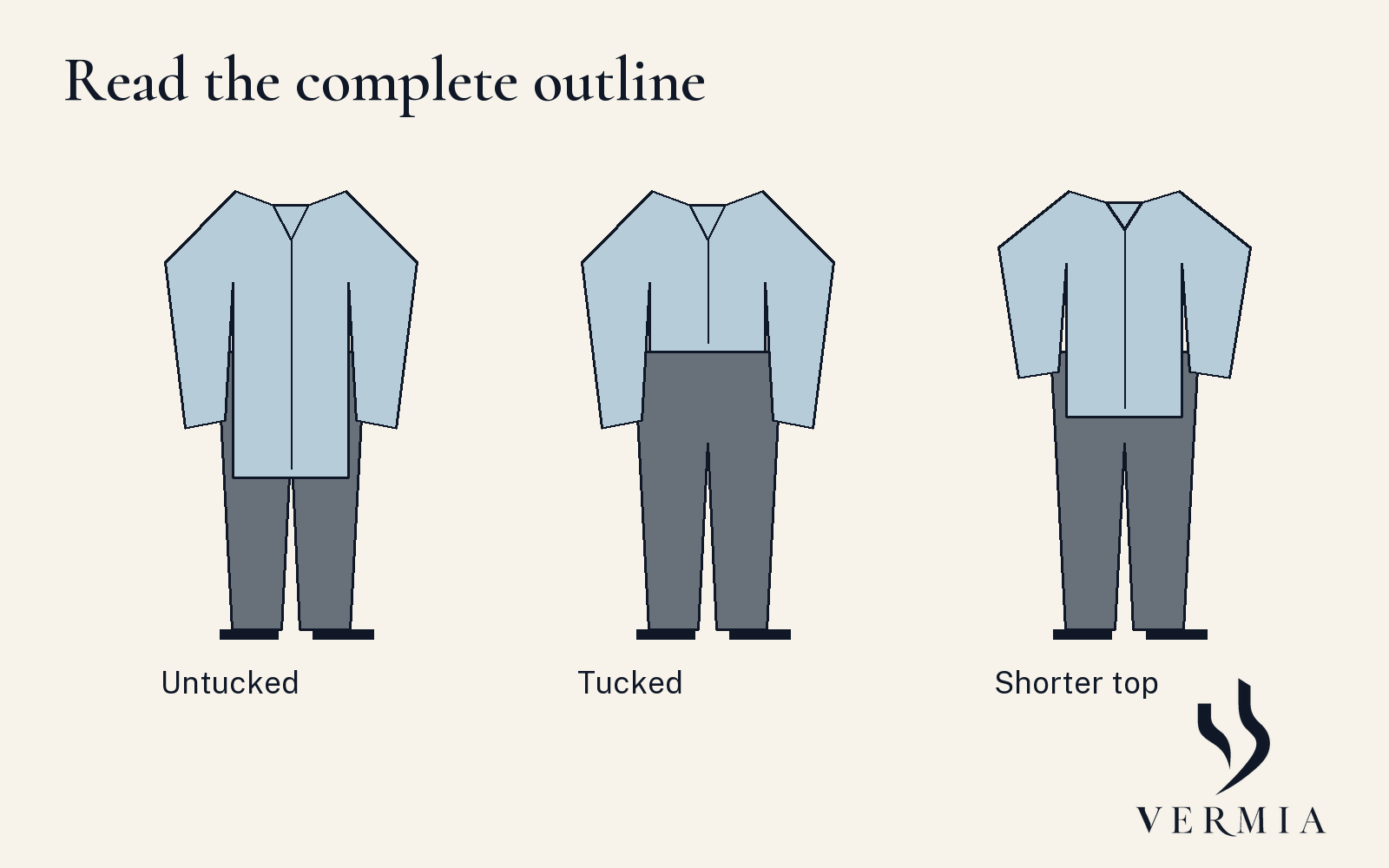
Put on a pair of trousers you find comfortable and the shoes you wear most often. Now compare an untucked shirt, the same shirt tucked, and a shorter knit. The trousers have stayed the same, yet the visible division between your upper and lower clothes has moved. That is a useful place to begin a proportion decision: a specific relationship you can see and change.
You can enjoy more than one arrangement. A roomy overshirt over straight trousers and a shorter top over wider trousers offer different outlines. This guide explains how to compare those options, including worked measurements and complete combinations. The examples are styling proposals; their purpose is to help you describe the version you prefer and identify the next useful question.
Begin with comfortable trousers
First establish that the trousers let you sit, walk and use the pockets as intended. Check the waistband in the position where the garment naturally sits on you. If you need to keep pulling it up or pushing it down, record what happens. Appearance and comfort both enter the decision; a preferred outline still needs to work through your actual day.
Use the same underlayers and pocket contents during a comparison. A phone or bulky object can change the way fabric hangs, while an extra tucked layer can affect the waistband. These details are easy to overlook when comparing a shop mirror with a photograph taken at home. Keeping them visible helps you interpret the difference without blaming your body or a single measurement.
If discomfort persists, describe its location and the movement involved before asking for fitting advice. A photograph alone cannot establish the alteration needed. Waistband shape, rise, seat, thigh room and construction can interact. An independent tailor can assess the actual garment and explain what is feasible. Treat that assessment as a separate question from deciding which visual proportion you enjoy.
Understand the waistband and rise together
Rise describes a dimension of the trousers; wearing position describes where they sit on you. Retail labels such as high, medium and low are useful starting words, but brands may apply them differently. Menswear writer Simon Crompton makes this distinction in his discussion of trouser rise. Check the actual garment's measurement method and intended position instead of relying entirely on the category name.
Then look at the top. A tucked shirt exposes the waistband and makes that boundary easy to see. An untucked shirt covers it and introduces another lower edge. A jacket can partly cover both. Before deciding that you want another rise, compare these arrangements with the same trousers. The visible change you want may come from the top's endpoint or wearing mode.
For example, keep charcoal trousers and brown shoes. Compare a pale blue shirt tucked, the same shirt untucked, and a shorter ivory knit. You may like the clear waistband in the first version and the relaxed lower edge in the third. Record both with their intended situations. There is no need to select one permanent ratio for every outfit in your wardrobe.
Read the leg through three positions
Look at the thigh, knee and opening together. Two pairs with equal room at the thigh can narrow differently below it. Crompton uses these positions to describe a trouser outline in his practitioner guide. Borrow the comparison points while keeping his personal dimensions separate from yours. A useful reference describes a garment you enjoy and where you usually wear it.
Consider two fictional candidates measured flat by the same stated method:
| Position | Pair A | Pair B |
|---|---|---|
| Thigh | 33 cm | 33 cm |
| Knee | 25 cm | 23 cm |
| Opening | 21 cm | 19 cm |
Both begin with the same listed thigh width, while Pair B narrows more through the lower leg. That is a shape difference to investigate. It does not tell us which will feel comfortable or suit a particular person. Fabric, construction and your intended use remain part of the decision. Confirm that the seller uses the same measuring points before comparing actual products this way.
Compare the width of the complete outfit
Put a roomy navy overshirt over Pair A, then try a closer blue shirt. Notice where the outline changes between upper and lower garments. You might enjoy a broad upper area above a more tapered leg, or a similar amount of room through both. Describing that relationship gives you a more specific preference than saying you always need slim or relaxed clothes.
Here are three starting arrangements to try with equivalents you own:
| Direction | Proposed combination | Detail to inspect |
|---|---|---|
| Room through both pieces | Boxy navy overshirt, roomy stone trousers, substantial dark shoes | Breadth through the complete outline |
| A broader upper area | Olive overshirt, straighter dark jeans, plain trainers | The change in width below the overshirt |
| A shorter upper boundary | Ivory knit, wider charcoal trousers, low-profile dark shoes | Top length and visible lower area |
The shoe descriptions concern visible shape. They do not rank quality or establish how well the shoes fit. Try the actual pairs, since a broad toe, thick sole or prominent welt can change the relationship at the trouser opening. A named shoe category contains many shapes. The complete outfit gives you the useful comparison.
Check length with the intended shoes
Look at where the hem meets the shoe when standing comfortably. Then walk and sit. Notice whether you enjoy the amount of fabric resting at the front, the view at the sides and the movement around the ankle. These observations are more useful than treating one hem position as correct for all trousers and footwear. Your preference may vary across different cuts and occasions.
If you change shoes, check again before assuming the trouser length needs alteration. A different sole height or upper shape can change the contact at the hem. Similarly, wearing trousers at a different waistband position changes their relationship with the floor. Restore the intended position before recording a length question. Keep the actual shoe in a reference photograph or fitting appointment.
When considering an alteration, discuss the complete result with a tailor. Shortening and narrowing are different changes, and their interaction can affect the leg line. Available cloth, existing construction and any turn-up also matter. Ask what will change and which features can be retained. A generic illustration cannot guarantee the result on your particular pair.
Work through one decision at a time
Imagine you enjoy the comfort and thigh room of your trousers, but the whole outfit feels longer through the upper area than you want. Keep the trousers and shoes steady. First tuck the shirt. Then try a shorter top. If either produces the boundary you enjoy, record that option before considering a change to the trousers.
Now imagine the upper boundary feels right, but the lower leg appears narrower than you prefer beside your shoes. Compare another comfortable trouser with a different knee-to-opening route. Keep the top and shoes where possible. You may find that a broader opening gives the relationship you want, or that another shoe changes it. These are alternative comparisons, with no prescribed ending.
If the candidate trousers also differ in colour, texture and rise, describe the complete preference. A real wardrobe rarely supplies a perfectly controlled pair. You can still learn that you enjoy this particular charcoal pair with the ivory knit. Leave the cause open until another comparison helps you distinguish it. Precise observation is useful even when it cannot isolate every variable.
Keep a record you can use again
Save the complete outfit with its wearing mode: shirt tucked, trousers at their comfortable waistband position, brown shoes, jacket open. Add one sentence about the relationship you enjoyed. For example: the shorter upper boundary and broader lower opening give me the outline I want with these shoes. This is an account of your preference in that arrangement.
If you shop later, translate the note into a question. You might ask for a trouser with room through the thigh and a less tapered lower leg, using a favourite pair's matched-method measurements as a reference. You now have something concrete to compare and discuss. Begin each new candidate with comfort and movement, then assess the outline in the intended outfit.
Make reference photographs comparable
If you photograph alternatives, keep the camera position, distance and your stance reasonably steady. Include the full trouser and the intended shoes. A close view taken from another height can make a different comparison from the one you saw directly. Use the image as a reminder of an outfit you have also tried, with the viewing differences recorded if they remain.
You can save two useful versions of the same trousers: one with a tucked shirt for a meeting and another with a shorter knit for dinner. Keep their notes separate. That gives the trousers a specific role in two arrangements, while leaving room for another shape on another day. The reference records your choices without turning a preferred proportion into a rule about your body.
Sources
- Simon Crompton, Trouser measurements, style and proportions, Permanent Style. Practitioner discussion of thigh, knee and opening relationships. Personal dimensions and opinions are not universal sizing rules.
- Simon Crompton, What are low, medium and high-rise trousers?. Practitioner vocabulary for rise and actual wearing position. No ideal waist location is prescribed here.
The measurements, outfit combinations and decision sequence are original illustrative examples derived from the Look book's proportion chapter. No measured change in perceived height, body size or confidence is claimed.