
An invitation says smart casual. You can picture a jacket and shirt, a knit with trousers, or dark jeans with the shoes you usually wear to dinner. The label leaves several practical questions open: what the host expects, how far you will walk, whether the venue is outdoors and how the evening will unfold. A few concrete facts can make the clothing choice much easier.
Begin with the event, then build the outfit. This guide offers a short briefing method and three hypothetical examples. They are adaptable proposals for stated circumstances. Global readers move among different communities and clothing traditions, so the relevant host or organisation remains the best source for its own expectations. A general etiquette guide can provide vocabulary while you establish that local context.
Separate a requirement from a clue
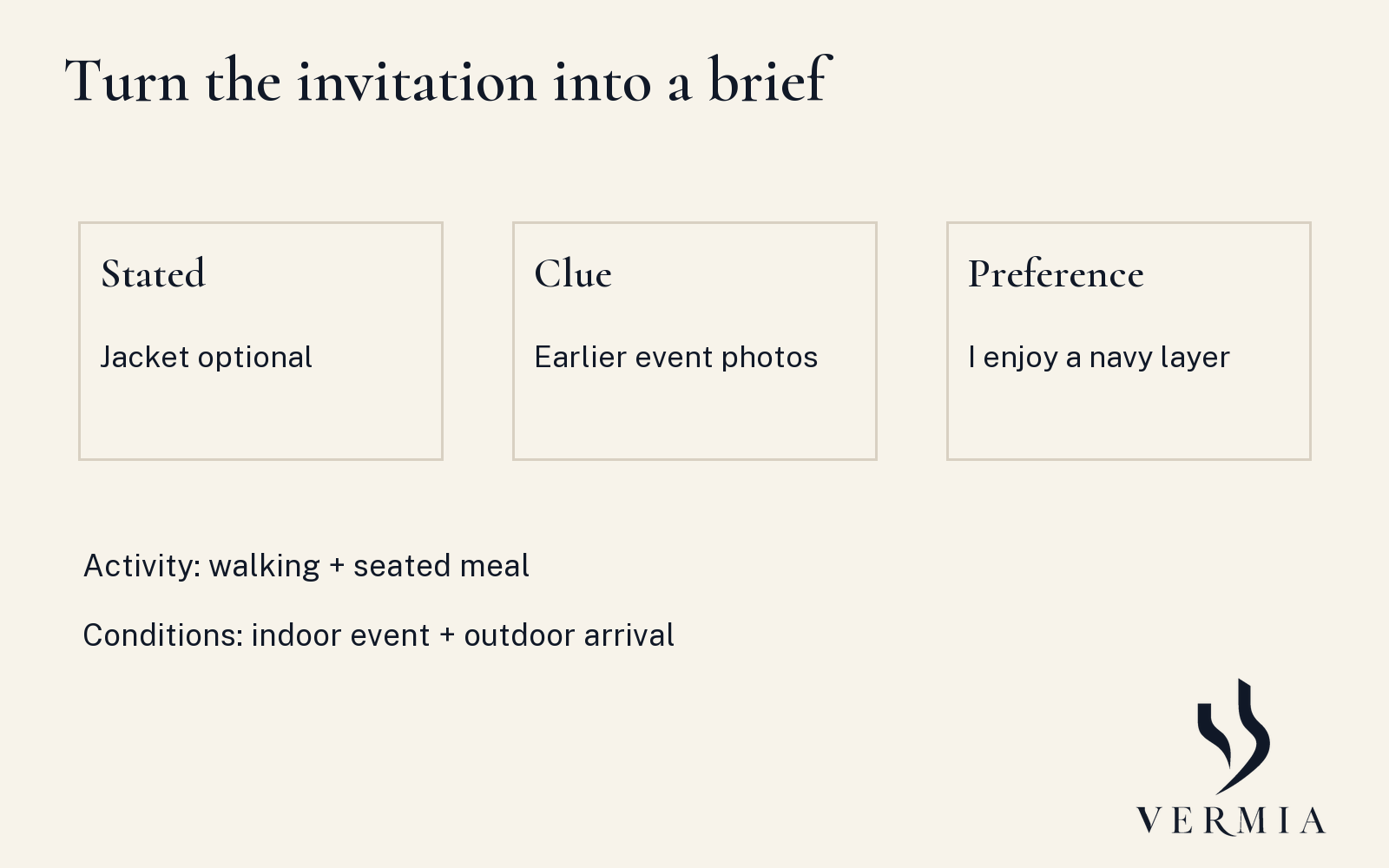
Write down exactly what has been stated. A request to wear a jacket is a requirement from the organiser. A photograph showing many jackets at last year's event is a clue. Your own enjoyment of a jacket is a preference. Each can contribute to the decision, but they answer different questions. Recording the distinction keeps an inference from quietly becoming a rule.
For example, an invitation may say smart casual while the host later explains that tailored trousers and a collared shirt are welcome, with jackets optional. You now have more useful information than the original label supplied. Keep the clarification with the event details. If you enjoy a jacket, you can choose one while recognising that the host has left that part open.
Recent photographs can suggest the range of clothes worn, but check whether they show the same type of event, season and group. A venue's promotional photograph may represent a special occasion. Treat it as a question-generating clue. If the dress expectation matters and remains unclear, a concise message to the host can resolve more than another round of browsing.
Ask a question the host can answer
Use a specific option: would a collared shirt and tailored trousers be appropriate, or would you prefer a jacket? This gives the host a concrete choice to respond to. For a workplace, ask the organiser or your contact about the actual meeting. Ask about its participants and any particular clothing expectations in advance. Keep any dress or access instructions they provide.
Ask about activities too. Will part of the event be outside? Is there a walk between locations? Will you be standing for a long time? An indoor meal and a reception across a garden can share a dress label while making different demands on footwear and layers. Those practical details belong in the outfit brief alongside the requested degree of dress.
Where a cultural or religious expectation may apply, ask the appropriate host or consult the institution's own instructions. Named Western codes do not translate automatically into every tradition. Keep the relevant requirements specific and respectful. There is room for personal preference within many settings, and that room becomes clearer when you know which details the host actually considers important.
Use etiquette references for their own contexts
Emily Post's attire guide describes a range of named dress conventions in a US-oriented etiquette setting. Debrett's explains British event and dress-code vocabulary. These can help when an invitation uses those conventions. Neither source establishes a single worldwide definition of professional or smart-casual clothing. Use the relevant reference to clarify a term, then return to the actual invitation and host.
Formal named codes also deserve their own preparation. If an invitation specifies black tie or another particular code, look up that code directly and ask about any alternatives the host permits. An ordinary jacket-and-shirt example cannot stand in for every formal requirement. Keeping that task separate makes the simpler smart-casual decision more manageable.
For the examples below, each host's clarification is part of the hypothetical brief. The combinations follow that brief and the person's preferences. They do not establish what everyone should wear to all dinners, work events or outdoor gatherings. You can use the sequence with your own facts and arrive at a different suitable arrangement.
Situation one: an indoor dinner
Suppose the host says that a collared shirt and trousers are suitable, a jacket is welcome and no tie is expected. The plan is a seated indoor meal with a short outdoor arrival. You enjoy a pale blue shirt, charcoal trousers and brown shoes. Start with those pieces and try the navy jacket you already wear with them.
Check the seated waistband, collar and sleeve movement. Put on the jacket and try the opening as intended. If you prefer another near-face colour, compare an ivory inner layer that still meets the host's clarification. You have a particular change to assess while the trousers and shoes remain familiar. Keep the option that feels comfortable and fits the stated expectation.
Add the outer layer needed for the journey, with a plan for where it goes indoors. If the event includes a cloakroom or similar provision, follow its arrangements. The useful outcome is a complete outfit for arrival, the meal and departure. A photograph of the indoor combination can include a note about the separate travel layer.
Situation two: an informal working event
Imagine a company gathering with presentations and conversation, where the organiser confirms that tailored trousers and a shirt or smart knit are appropriate. There is no client-facing uniform requirement. You will carry a laptop and spend part of the day seated. A muted blue shirt, navy trousers and comfortable shoes can be a starting proposal using clothes you already enjoy.
Try the actual bag and pocket contents with the outfit. Sit, stand and reach as you expect to during the day. If you are presenting, check the view on the intended camera or screen arrangement where possible. A fine pattern may behave differently on a recording than in the mirror. That is a practical equipment question to test in addition to your direct view.
If you prefer a jacket for presenting, include it in the movement check. Record that it is your chosen arrangement within the organiser's stated range. You can use another permitted combination for a different day. An outfit preference can support preparation without becoming a claim that a particular colour or garment will make other people judge your competence accurately.
Situation three: a gathering with an outdoor section
Suppose the host clarifies that the gathering is relaxed, with a short garden reception followed by an indoor meal. A collared knit or shirt and trousers are welcome. Choose the clothing around both parts of the plan. An ivory knit polo, olive trousers and a navy outer layer offer one proposed direction, with footwear chosen for the actual surface and walking involved.
Check the weather information relevant to the day when preparing, and keep any shelter or venue instructions in mind. The visual character of a fabric does not establish its warmth or weather performance. Use the garment's actual construction, supplied information and your experience of wearing it. If you need another practical layer, make room for it in the complete try-on.
Try the outfit with the outer layer removed as well. You may spend much of the meal in the inner combination. Notice whether you enjoy the colour, neckline and trouser relationship in both states. Keep the arrangement you would use at each stage, so the outfit remains useful when the conditions change.
Make the final brief short enough to keep
Use five lines: stated clothing expectations, location, activities, expected conditions and your chosen outfit. Add one unresolved question if necessary. A brief for the dinner might read: jacket optional; indoor meal; short walk and seated dinner; travel coat needed; pale blue shirt with charcoal trousers and brown shoes. That is enough to guide preparation.
Lay out the clothes with the actual shoes, bag and layers. Check that anything needed for wear is available and cared for. If a garment needs repair or cleaning, keep that task separate from the styling decision. An appealing combination that cannot be worn on the day needs another practical option. Try that option while there is time to compare it.
After the occasion, add one observation you would use next time: the layer was useful for arrival, the waistband stayed comfortable, or another shoe would suit the walk better. This personal record makes the next similar invitation easier to interpret. You are building knowledge of actual settings and your own preferences, one complete outfit at a time.
A message you can adapt
For an unfamiliar event, a short note could read: “I am looking forward to joining you. Would a collared shirt and tailored trousers be suitable, and is a jacket expected? I also wanted to check whether part of the evening is outdoors.” Replace those options with clothes relevant to the invitation. The message asks about concrete expectations and conditions, giving you information you can use immediately when preparing the outfit.
Sources
- Emily Post Institute, Attire Guide: Dress Codes from Casual to White Tie. US-oriented etiquette conventions; not a universal workplace or cultural rule.
- Debrett's, Events and Dress Codes. British named event conventions, used as contextual vocabulary.
The three situations, host clarifications, outfit proposals and five-line brief are original hypothetical examples. No real host, event or reader outcome is represented.