
Open your wardrobe with one ordinary week in mind. Perhaps it contains desk work, a meeting, a commute and an evening meal. Start with clothes that already feel comfortable and suit those activities. You are looking for combinations you would willingly repeat. A small rotation can begin with a handful of pieces you own and a clear account of where you want to wear them.
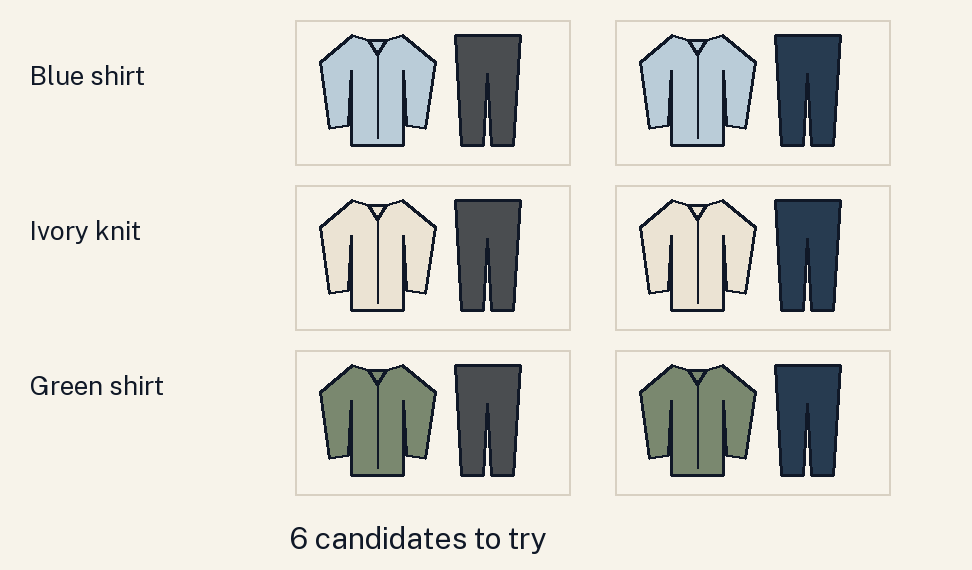
Three tops and two bottoms give you six candidate pairings. Some may suit the week well; others may need a different layer, a different wearing mode or a different occasion. The useful result is the set you have actually tried. This approach helps you see what already works before deciding whether anything else would make a meaningful difference.
Begin with the requirements of your week
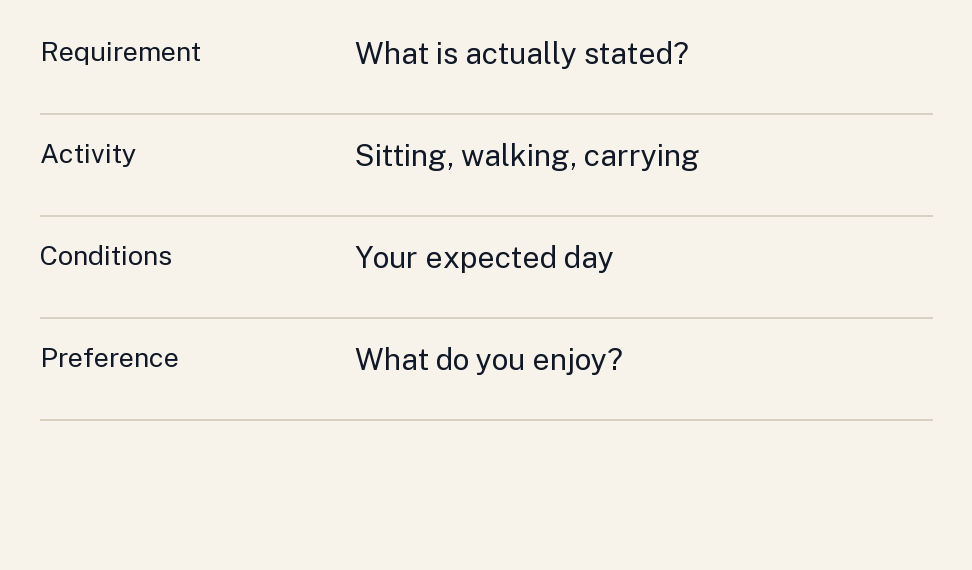
List the situations that affect your clothing choices. Include any stated dress requirements, the activities you will do and the conditions you expect. A workplace's own instructions are more useful than a broad internet definition of business casual. A meeting invitation may specify a code; an ordinary working day may allow more choice. Keep those sources of information distinct.
Then add practical details: walking, sitting for long periods, carrying a bag or moving between indoor and outdoor spaces. These can change which combinations are comfortable and appropriate. Leave room for your preferences as well. You may enjoy a collared shirt for an informal meeting even when it is optional. A useful rotation accommodates that preference without making it a rule for everyone.
Choose one or two situations for the first attempt. A rotation for desk days and informal dinners is easier to assess than a set expected to cover every possible event. Separately note any occasion requiring specific clothing that these pieces cannot provide. That gap can remain a distinct future decision while you make the ordinary week easier to dress for.
Select a small group with useful differences
For a worked example, set out a pale blue woven shirt, an ivory knit polo and a muted green shirt. Add charcoal trousers and dark indigo jeans. The example is a styling proposal, with imagined pieces that already fit and feel comfortable. Use equivalents you own. Their actual cut, fabric and condition will decide how the combinations behave.
These tops offer differences in colour and neckline while staying within a relatively restrained range. The two bottoms offer different surfaces and possible contexts. You could choose an entirely different direction: darker tops, warmer colours, a more relaxed trouser shape. Keep one or two features you genuinely like as the starting point. Repetition can help a small set feel personal and coherent.
Lay out the pieces where you can see them together. Notice whether one item needs a particular companion or wearing mode. A long shirt may work best tucked; a knit may need enough room beneath your preferred jacket. These observations are useful constraints. They help you understand the set you have, without forcing every garment to be interchangeable with every other one.
Read six pairings as six questions
With three tops and two bottoms, the arithmetic is three multiplied by two. Make a simple grid and put one pairing in each cell. Pale blue with charcoal is one candidate; pale blue with indigo is another. Continue for the ivory and green tops. At this stage you have an inventory of possibilities, with no promise that all six will earn a place.
Try the candidates with the shoes you would use. Tuck or untuck the top as intended, then look at the complete arrangement. Check comfort seated and moving. Notice whether the hem, waistband and shoe work together in a way you enjoy. If a combination needs a jacket to feel complete to you, record that dependency beside it.
Give each candidate an ordinary description: repeat for desk days, useful for dinner, try with another layer, or leave out of this rotation. These labels describe decisions you can act on. You do not need a numerical style score. A set of four combinations you enjoy wearing can be more useful than a grid of six you have never put on.
Give each useful piece a role
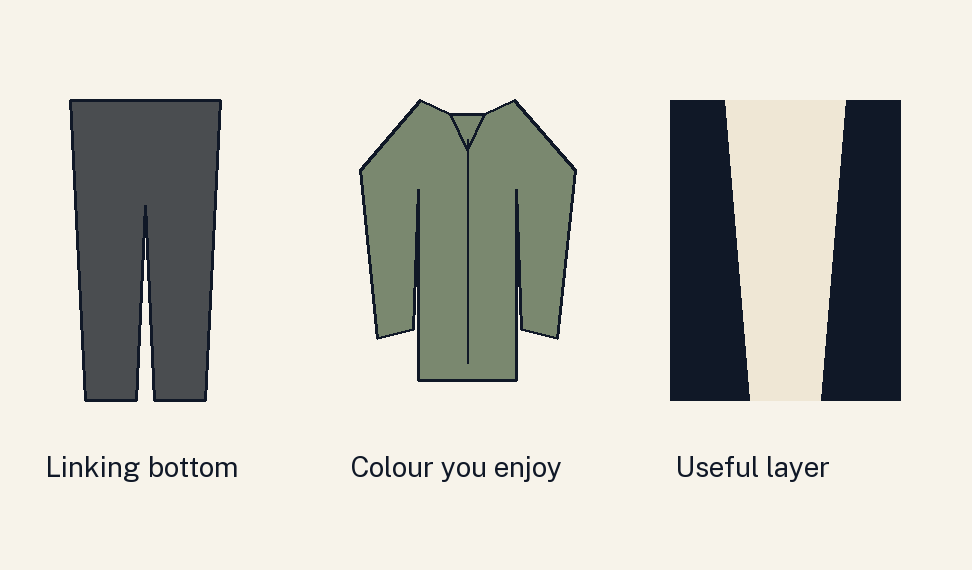
Look for the pieces that link several candidates. Charcoal trousers might support both your pale blue shirt and ivory knit. The green shirt might supply a colour you particularly enjoy. The indigo jeans might belong mainly to evenings or a more relaxed work setting. Naming those roles can explain the rotation more clearly than trying to label your entire personal style.
You can also identify one feature to repeat. It might be muted colour, a comfortable straight trouser shape, an open neckline or a visible woven surface. Keep that feature in a few combinations and vary another one. You may discover that the repetition is what you enjoy. Personal preferences become easier to use when described through actual garments and arrangements.
If an item remains difficult to combine, ask what it needs. Perhaps its depth is close to your other clothes but its shape requires a different trouser. Perhaps it suits a separate occasion. You can keep it outside this small rotation without deciding that the item itself was a mistake. The aim is to organise a useful set for a defined part of your life.
Add a layer after the base combinations work
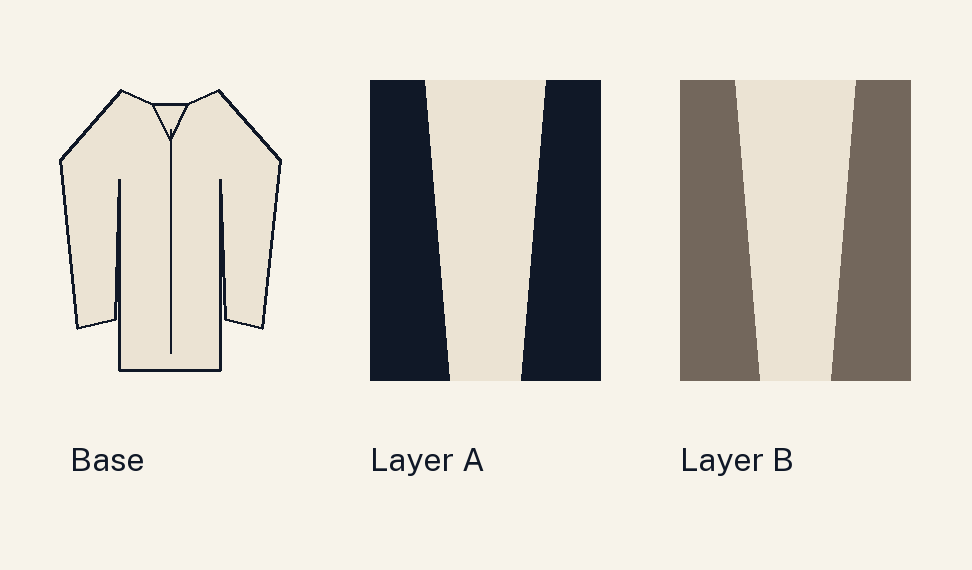
Choose an outer layer you already wear. Try it over the candidates you kept, leaving enough time to assess movement and closure. A jacket changes the visible colour areas, the neckline and the silhouette. The sleeves and body also need to accommodate the inner garment. A colour combination on a bed cannot answer all of those questions.
Two layers paired with six base candidates create twelve layered candidates on paper. Add the six unlayered versions and the total is eighteen possibilities. This is counting, not a claim that five garments and two layers deliver eighteen suitable outfits. Climate, fit, activity and preference can remove several. Record the versions that survive a real try-on and suit the situations you named.
For example, the ivory knit may sit comfortably beneath one jacket but gather under another. The pale blue shirt may work with both. Keep those different results. The information helps you dress and also helps you assess a future purchase. A layer that works with several combinations you already use has a concrete purpose you can inspect.
Make a record that helps on a busy morning
Photograph a complete combination you liked, including the shoes and intended state of the outer layer. Add a few useful words: shirt tucked, jacket open, suitable for the informal meeting room. Keep photographs private unless everyone shown has agreed to their use. The record only needs enough information for you to recreate the outfit without repeating the whole decision process.
After wearing a combination, add what happened. Did the shirt stay comfortable seated? Was the layer useful for the journey? Would you choose a different shoe for more walking? These are observations from your own day, not a controlled experiment. They are valuable because they describe the circumstances in which this particular combination worked for you.
Review the rotation after several wears. If a piece needs care or repair, make that the next action. If you notice a recurring gap, describe it precisely before shopping: an inner layer that works with these two trousers and this jacket, for example. Start by trying another piece you already own. You can then judge whether an addition would serve several real combinations.
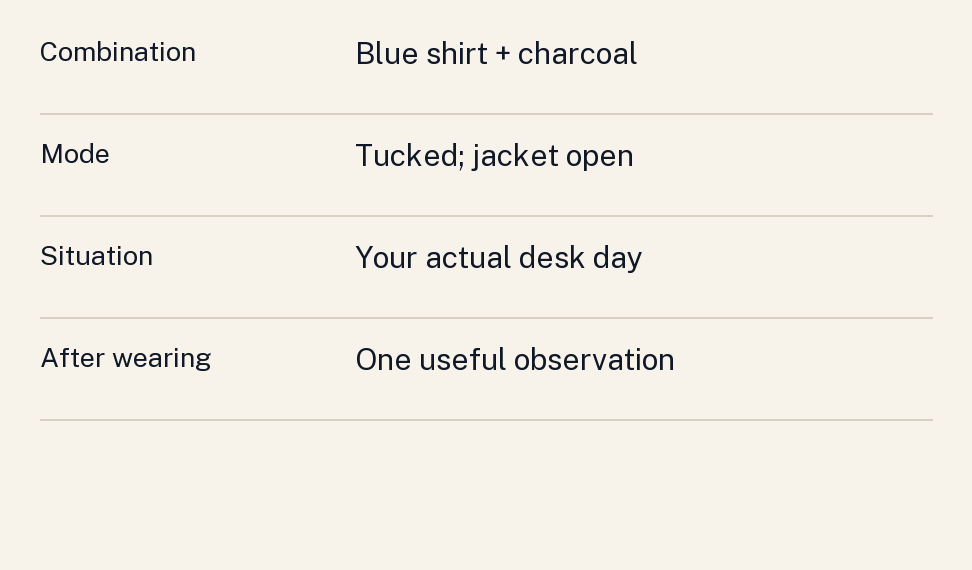
Read a week from the finished grid
Suppose your pale blue shirt and charcoal trousers become a favourite for desk days. The ivory knit with charcoal feels right for an informal dinner. The green shirt with indigo works for a relaxed afternoon, while the pale blue and indigo combination gives you another option where jeans are appropriate. These are four hypothetical results from trying the example set. Their usefulness depends on the actual setting and clothes.
The remaining two cells can stay open. Perhaps the ivory knit's hem sits differently with the jeans, and you want to compare another wearing mode. Perhaps the green shirt with charcoal looks good to you but feels restrictive beneath the jacket you need that week. Write those particular questions in the grid. You have a specific adjustment to investigate instead of a vague conclusion that the whole wardrobe needs changing.
If your week contains three desk days and two informal evenings, four useful combinations may provide enough choice for that first rotation. Laundry needs, climate and how often you want to repeat clothes still matter. Avoid assigning a fixed number of wears to every reader. Keep the rotation flexible as those conditions change, and retain a separate option for occasions with different requirements.
The exercise ends when the record helps you choose an outfit. You can expand it later with another top or layer, using the same checks. Start that expansion with a clear role for the piece and the combinations you want it to support.
Sources and method
This is an original wardrobe exercise. The worked garments and candidate counts are illustrative. No fixed wardrobe size or measured time-saving benefit is claimed.
- Emily Post Institute, Business Casual Attire Guide. A US-oriented reference point; your actual setting's requirements take priority. It does not establish a global workplace code.
- CIE, perceived colour, e-ILV 17-22-040. Supports checking arrangements under relevant viewing conditions, without determining personal preferences.
The grid counts possible pairings. Comfort, construction, local expectations, weather and your preference determine which become useful outfits.